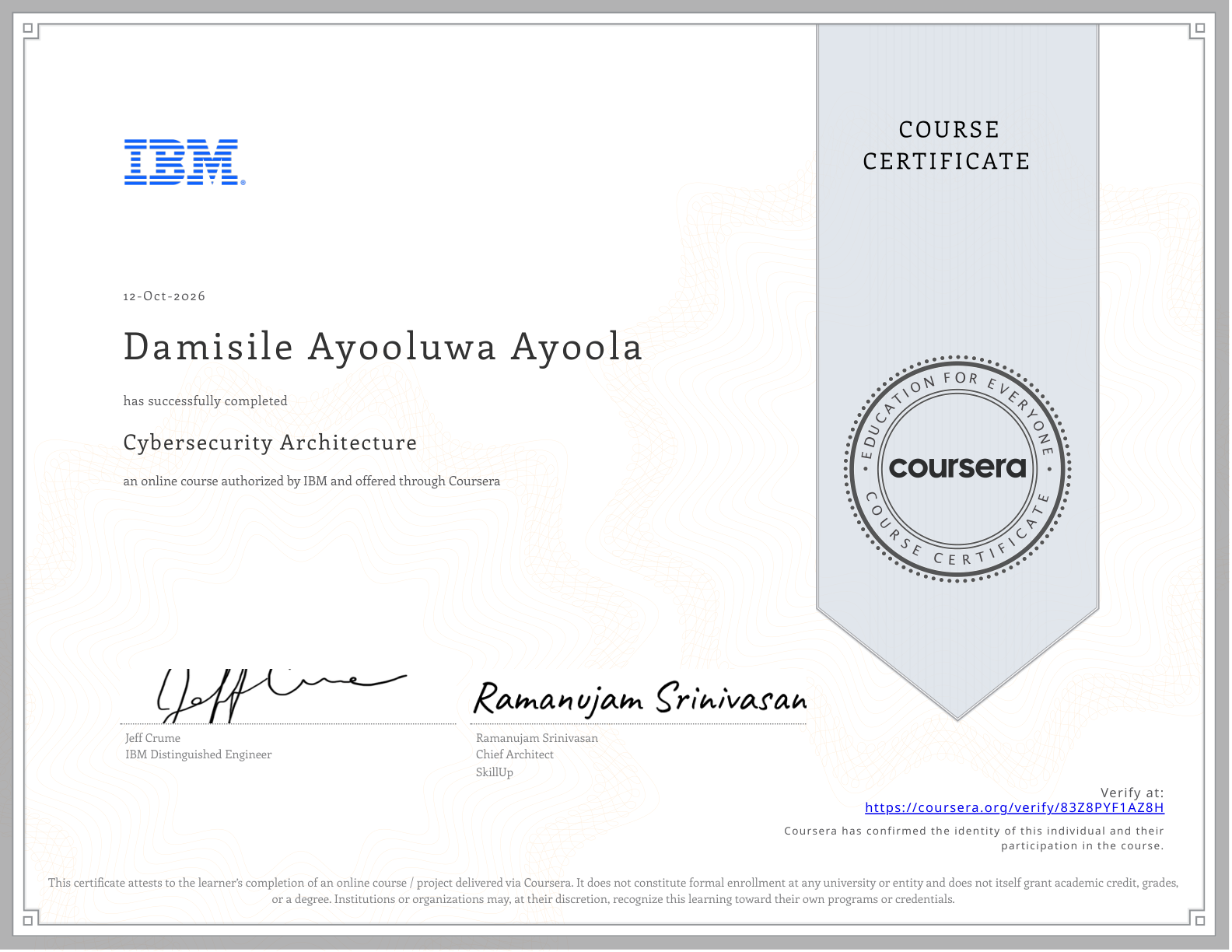
Last year I shipped code and hoped it was secure. This month I am an IBM-certified Cybersecurity Architect. The certificate is paper; the real payload is a mindset transplant — and it changed how I write every line of backend code.
Threat modeling first, features second
The core habit the course drills in: before designing a system, enumerate how it breaks. Who are the actors? Where does untrusted input enter? What is the blast radius if this credential leaks? Most developers — past me included — build the happy path, then bolt on security as decoration. Architecture inverts that: the threat model is the design input, and features fit inside the remaining safe space.
Three ideas that stuck
1. Defense in depth beats any single control. No cipher, firewall, or review process survives alone. Security comes from layers that fail independently — so one breach never becomes total compromise.
2. Least privilege is a lifestyle, not a checkbox. Every secret, service account, and dependency should hold the minimum power it needs. This is why my secrets manager injects credentials straight into process memory instead of leaving them on disk: less exposure surface, fewer assumptions.
3. Assume breach, design recovery. Architecture accepts that incidents happen and optimizes for detection speed and blast-radius containment — audit hooks, pre-commit leak blocking, fast rollback — rather than the fantasy of perfect prevention.
Applied immediately
I took the new lens straight to envvault, my open-source secrets manager: AES-256-GCM encryption, memory-only secrets, a pre-commit hook that blocks plaintext leaks before push. The course didn't just validate those choices — it gave me the vocabulary to explain why each layer exists, which is what turns a tool into a trustworthy one.
If you are a developer wondering whether security certifications are worth the hours: the credential opens doors, but the mindset pays rent every single day. Start with one habit — model the threats before you write the code. My full learning path, including Google AI credentials, is on LinkedIn and Credly.